

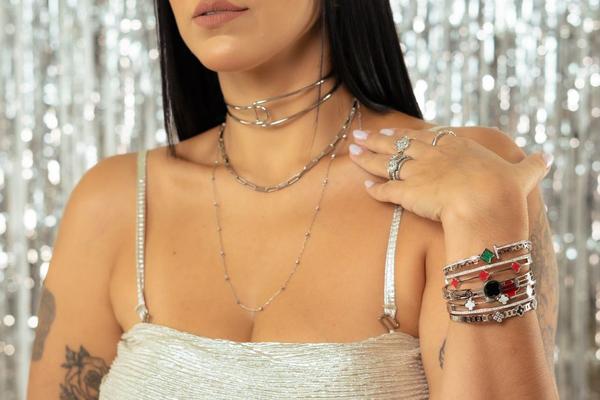
Stacked rings are having a strong 2026 moment, but the appeal goes beyond piling jewelry onto every finger. The best stacks look collected rather than crowded: one substantial band, one slim accent, perhaps a stone or sculptural shape, and enough space between them for each piece to register. Recent runway and bridal jewelry coverage has leaned into layering, mixed metals, and chunkier ring profiles, which makes the stacking rings trend feel less like a passing microtrend and more like a flexible way to build a personal jewelry wardrobe.
Why Ring Stacking Feels Fresh Again
Ultra-delicate bands dominated everyday jewelry for years. Now, more visible shapes are returning. Wider bands, bold bezels, textured surfaces, and two-tone combinations add contrast, while stacking lets you wear stronger pieces without committing to one oversized statement ring.
The shift also reflects a move toward personal styling. A stack can combine a vintage ring, a new band, a sentimental piece, and something inexpensive without matching perfectly. That is one reason the mixed metal rings trend works so naturally here: silver, yellow gold, rose gold, and white metals can look intentional when they repeat across the hand.
Start With One Ring That Sets the Tone
If you are learning how to stack rings, begin with an anchor piece. This is the ring that carries the most visual weight. It could be a wide polished band, a signet, a bezel-set stone, or a sculptural ring with a distinctive curve. Once that anchor is chosen, the other rings should support it rather than compete with it.
A useful rule is to vary scale. Pair a 5-7 mm statement band with one or two slimmer bands rather than surrounding it with pieces of the same width. If every ring is equally bold, the stack can look blocky. If every ring is extremely thin, the result can disappear from a distance.
Use Proportion, Not Symmetry
Good ring stacking ideas often look slightly asymmetrical. Instead of building identical stacks on both hands, distribute visual weight. You might wear three rings on one hand and two on the other, or keep one finger bare next to a heavier stack. Negative space is part of the design.
Finger length matters too. A tall stack can overwhelm a short distance between the knuckle and the base of the finger. If your fingers are shorter, use fewer bands or alternate a medium-width ring with very slim ones. Longer fingers can usually handle more vertical layering, but comfort still matters more than filling space.
How to Mix Metals Without Making the Stack Look Random
Mixing metals is easiest when one tone appears more than once. For example, if your anchor ring is yellow gold and you add a silver band, repeat silver elsewhere on the same hand or in another piece of jewelry. That repetition turns contrast into a color story.
Two-tone rings are especially useful bridges because they visually connect warm and cool metals. You can also repeat a finish instead of a color: a brushed silver band can sit comfortably beside brushed gold because the shared texture creates consistency.
Combine Texture and Stones Carefully
A ring stack becomes more interesting when the surfaces change. Try combining smooth metal with rope texture, hammered finishes, milgrain edges, pavé, or a bezel-set stone. The key is not to use every texture at once. One detailed ring usually looks better when the surrounding pieces are calmer.
Stones can also create spacing. A low-profile bezel or small solitaire acts as a visual break between metal bands. If you wear a larger center stone, check how neighboring rings sit against the setting. Rings that rub constantly against prongs or delicate pavé can cause unnecessary wear, so a small gap or a compatible contour band may be smarter.
A Simple Three-Ring Formula That Works
For a practical everyday stack, start with a medium-width gold band as the anchor. Add a thin silver band on one side, then a narrow ring with a small bezel-set stone on the other. Keep the widths different and let the silver tone appear again on another finger. The result feels layered, but each ring still has a job: the wide band gives structure, the slim band adds contrast, and the stone adds a focal point.
This is also an easy formula to adapt. Swap the stone ring for a twisted band for a softer look, or replace the polished anchor with a signet if you want more presence. The principle stays the same: one dominant element, one quiet supporting element, and one detail that adds personality.
Spread the Stack Across the Hand
Not every stacked look needs multiple rings on one finger. Wearing rings across several fingers can feel modern and comfortable. A substantial index-finger ring, a slim middle-finger band, and a small pinky ring can create balance without crowding one finger.
If you already wear a wedding or engagement set, treat it as part of the overall hand rather than a separate styling problem. Keep the opposite hand slightly simpler, or echo one metal or shape from the bridal stack so the two hands feel connected.
Common Stacking Mistakes to Avoid
A common problem is buying rings individually without considering how they sit together. Width, height, setting style, and fit all affect the result. Try the stack on for several minutes. Make a fist, type, hold a phone, and notice whether the rings pinch, spin, or rub.
Another mistake is forcing a perfectly matched set. The most convincing stacks usually contain some contrast. If you want more ideas for coordinating bolder pieces, a statement ring styling guide is a useful next read. A guide to choosing rings for your hand shape can help with proportion, while a mixed-metal jewelry guide can expand the same approach beyond rings.
FAQ
How many rings should be in a stack?
There is no fixed number, but two to four rings on one finger is a practical range for most everyday stacks. Comfort and proportion matter more than quantity.
Can you mix gold and silver rings?
Yes. Mixed metals can look deliberate when one tone is repeated elsewhere in the stack or across the hand. A two-tone ring can also help connect the colors.
Should stacked rings be the same width?
Usually not. Combining different widths creates contrast and helps the eye separate each ring. One wider anchor band with one or two slimmer companions is an easy place to start.
Can you stack rings with an engagement ring?
Yes, but check the profile and setting. Bands that press against prongs, pavé, or a raised center stone can cause rubbing. A contoured or spacer band may give the engagement ring more room.
Build a Stack That Looks Like Yours
The strongest version of the stacking rings trend is not about copying a preset combination. It is about balancing scale, metal, texture, stones, and empty space until the group feels intentional. Start with one anchor ring, add contrast gradually, repeat one visual element, and stop when the set feels complete rather than full. A well-built stack should look effortless, but it should also be comfortable enough to wear without thinking about it.
